Between a Rock and a Hard Place
Posted: August 20, 2015 Filed under: Healthcare Leave a comment
As I have spent most of my adult life worrying about a single industry, I thought it may be helpful to describe, in my words, the framework of the US healthcare delivery system. If you come from a healthcare discipline, you may find this overview to be a naive oversimplification. But for the rest of you, I thought you may appreciate my attempt to demystify what is arguably the most important, and probably most complex, industry on earth.
As with most things in life, perhaps we can make the complex simple by separating this mega-industry into bite-sized chunks. Let’s examine the structure of the healthcare industry at the 30 thousand foot level.
Every healthcare event has the following components:
- Patient: ultimate beneficiary of the full set of services or products intended to aid recovery from an illness or accident, or to ensure optimal ongoing health
- Provider(s): the professional (or set of professionals) that render services, prescribe other procedures or products (e.g. prescription drugs), and collectively have accountability for the clinical result, or outcome. Providers are either individual professionals (e.g. physicians, nurses, physical therapists), or facilities (e.g. hospitals, radiology centers, diagnostic labs)
- Economic Payer(s): the entity (or entities) responsible for supplying the financial resources necessary to pay for the services and products delivered
- Payment Custodian: the entity which governs and manages payment to the provider
Note that some entities may adopt more than one role. For example, through co-pays and deductibles, the patient also becomes an economic payer. Additionally, in the case of an integrated delivery network, or IDN (such as Kaiser Permanente here in the West Coast, or Partners Healthcare in the Boston area, or Ascension Health in the Midwest), a single entity can simultaneously deliver the service, manage payment for the service, and provide the actual economic resources. In other cases, a self-insured employer (most large companies such as Bank of America, or General Motors) provides the economic resources for delivery of healthcare services but another third-party (such as UnitedHealthCare, or Aetna) is the custodian of the payments. So although the employer funds the services, a separate healthcare-savvy firm (third-party administrator, or TPA) manages disbursement of those funds — for an administrative fee. Another thing to keep in mind is that about half of all US healthcare expenses are paid by the US government, through Medicare and Medicaid programs (Centers for Medicare and Medicaid Services, or CMS). And whenever CMS changes, the entire industry reacts.
Background: What’s Driving Change?
When all is said and done, the motivations and resulting behaviors across the healthcare industry are heavily influenced by reimbursement. In other words, whenever healthcare services or products are delivered, someone needs to pay. In a simple world, we would treat healthcare like any other business. If we were to get sick, we would visit a physician who would render his or her services, and we would get out our checkbook and pay the bill. Like changing the oil in our car, or getting our house painted. However, unlike an oil change, healthcare costs are far more difficult to anticipate. This can be true for single procedures (I will blog later on the topic of cost transparency), but it is also amplified by the fact that what may start as a single, simple procedure may result in a much more complex, much more expensive set of tests and procedures. So healthcare costs are often mysterious, hard to forecast, and they can be highly variable, ranging from a few dollars to hundreds of thousands of dollars, or even more. It would be like dropping your car off at the dealer for a $40 oil change, and not learning until you pick it up the next day that they replaced your $6,000 engine instead! Furthermore, most business transactions have limited downside. In the case of your car, what’s the worse that could happen? If you do blow your motor and the expected repair bill is more than the car is worth, you salvage the car and purchase a new one. Certainly not a pleasant outcome, however it is still more palatable than being faced with a life-or-death healthcare treatment decision. With healthcare, there is no downside limitation, and your very life can be at stake.
To help buffer these dramatic variations, and the economic and personal risks associated with them, a concept known as risk pooling was introduced, or as we commonly refer to it, insurance. With risk pooling, a large number of people each pay into a common fund. As various members of that population then require healthcare services, money is drawn from that common fund as required. The theory is that many people will only require minimal and emergency care, therefore the amount they pay into the pool is more than the cost of their individual care. But offsetting this, others will require more care, and (hopefully) only a very few will require extensive (very expensive) care. So insurance is a way to distribute this variability risk across a large number of people, and to remove the potentially devastating economic “surprise” for the few unlucky folks that draw the short straw. Of course, a critical element when pooling risk is the calculation of the amount each individual needs to contribute. This is a very complex computation which considers the number of people contributing, and a clairvoyant attempt to forecast the future as it relates to how many people will become ill, how many will see a primary care physician, how many will visit a specialist, how many lab tests and radiology orders will be written, how many will suffer expensive and complex events such as heart attacks or cancer, and how many will be cost-free by “toughing it out” with over the counter medication and self-care. Our government payers (Medicare and Medicaid) represent roughly half the total medical spend in the United States, and those pooled medical expenses are paid by all taxpayers. The majority of the rest of the U.S. medical spend is borne by employer-based plans, meaning U.S. employers contribute to the risk pool. A much smaller portion is then covered by direct out-of-pocket and individual plan payers.
A fundamental challenge with this model is that most of us are wired to make individual decisions, not “good of society” decisions. As an example, if a loved one has a care need and an outrageously expensive treatment exists, we are likely to insist on providing that treatment, even if the treatment represents only a slight chance to resolve the problem. On top of this, health care providers are often paid on a procedure bases, or what is referred to as fee for service. In a fee for service world, the more procedures a physician performs, the more money he or she makes.
So healthcare finds itself wedged between a rock and a hard place. Most healthcare expenses are drawn from risk pools that are largely funded by taxpayers or employers. These pools are limited, yet the demand to draw from them tends to be practically unlimited. So something has to give.
Throughout the history of healthcare, various initiatives have been initiated in an attempt to somehow manage demand. The introduction of diagnostic related groups (or DRGs) in the 1980’s was an attempt to restrict hospitals by determining in advance how much they would be paid for each of the reasons people were hospitalized — hospitals no longer had a blank check. Patient co-pays and deductibles were also introduced, in an attempt to share some of the economic risk with the patient — “If I have to pay $25 to see the doctor for this cough, do I REALLY need to go, or can I wait to see if it gets better on its own?”. Then, throughout the 1990’s, the notion of health maintenance organizations (or HMOs) were implemented to manage cost by economically rewarding providers to avoid unnecessary care, as well as encouraging better coordination across all of the specialty providers to eliminate redundant serv
ices. Although these moves have all helped to some extent, the graph to the left proves that none of 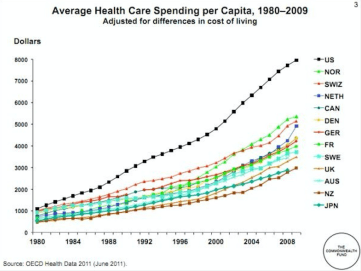 them have solved the root cause issues of spiraling costs: as you can see, the spending per person on healthcare in the US (the top line) is significantly higher than healthcare spending in any other country. And what results do we get in return? According a study by a well respected foundation (the Commonwealth Fund: click here for more information), the US ranks dead last in multiple measures of healthcare quality among 11 countries (Australia, Canada, France, Germany, the Netherlands, New Zealand, Norway, Sweden, Switzerland, the United Kingdom, and the United States). Something is clearly and seriously wrong.
The Affordable Care Act
With the passing of the Patient Protection and Affordable Care Act (or ACA) in 2010 (upheld by the US Supreme Court in 2012), ten new “titles” were introduced into law, in a sweeping reform of the US healthcare ecosystem. The intent of the ACA is to ensure that more people were covered through public and private insurance plans, to increase the quality and affordability of health insurance, and to reduce overall costs of healthcare for individuals and the government. In other words, to produce better health results while spending less money. But within that one sentence is the most impactful overhaul of the US healthcare system in 30 years. And with revolutionary change comes tremendous opportunity.
As a consequence, all of us in the healthcare industry are becoming more aligned to what really matters. Concepts such as delivering and measuring overall quality of the patient experience and outcome as it relates to the resources necessary to deliver that outcome (“Value-Based Purchasing”). And simultaneously delivering the trifecta of the (1) most positive patient experience, (2) ensuring better health of the total population, and (3) with reduced resources and cost (“Triple Aim”). Not to mention worrying about keeping people healthy from the start, and keeping them out of the healthcare system altogether!
So with a single stroke of the legislative pen, sensible concepts which should have been woven throughout the fabric of our healthcare system from the beginning of time have led to a rethinking of everything we have learned about delivering care. From my perspective, it is largely for the better, and it opens up tremendous opportunities for innovation that benefits all of us.
So stay tuned — I have made a personal decision to be on the front lines of this revolution in US healthcare delivery. As I join in the fight to rebuild this entire $3 trillion industry brick-by-brick, I will provide glimpses of progress and perspective through my blog. Please feel free to share your thoughts below. And hang on for the wild ride.
(check out our personal website here: curd.net)

 Steve Curd